
The Viewing Experience: Rugby
- Mar 18, 2020
- 4 min read
Updated: Mar 29, 2020
Rugby is a beastly game played by gentlemen. Soccer is a gentleman's game played by beasts – Henry Blaha
Through the years, the traditional British sports of rugby and soccer have been compared and contrasted. Rugby is often thought of as the younger brother; slower to professionalise, slower to commercialise, and still some way behind. And yet, as the world watches soccer’s flawed and faltering attempts to introduce sport technology, I am reminded of the ways in which rugby has seamlessly implemented technology in order to improve the sport for all.
For a sport so wide in popularity, soccer struggles with some seriously narrow-minded thinking. As Conor Corry talks about in his piece, the late arrival of VAR to soccer has brought great controversy. One of the sources of frustration is the general lack of transparency, an issue which is rare in rugby. Rugby has integrated technology in a clear and cohesive manner since the turn of the millennium, despite only becoming professional in 1995. Every advance has been done with supporters, players, coaches, and referees in mind. It seems that in rugby, even the most beastly of men, have used their brains rather than their brawn.
TMO Technology

The Television Match Official (TMO) was introduced to rugby in 2000 to ensure consistent and accurate decisions on the field. The TMO works with the referee primarily to identify if a try has been scored without infringement, or to identify possible foul play. The advantage of using the TMO is that they can view many replays of incidents which other match officials may only see once, or not at all. However, World Rugby are clear in their instruction that “the referee should not be subservient to the system.”
In many ways rugby’s TMO is similar to soccer’s VAR, but it is more transparent. When the TMO and referee are deliberating a decision, the replays are shown both in the stadium and on television broadcasts. That way supporters, players, coaches, and referees can see the same thing. Furthermore, the dialogue between match officials is broadcast for further clarity and transparency.
Hawk-Eye video replay technology was introduced in the 2015 Rugby World Cup. It puts independent match officials in control of the replay angles, rather than host broadcasters. One of the unexpected benefits is how the replays are able to help medics identify head injuries. The technology also allows multiple angles to be viewed simultaneously, it allows slow motion replays, and it allows increased zoom functionality. All of these advances have helped to ensure accurate decision making by referees, while also maintaining the transparency that ensures an enjoyable viewing experience.
GPS Technology

Interestingly GPS technology was first used in rugby in 2001 to monitor the workload of referees rather than players. Irish provincial teams were among the first teams to embrace the technology for match and training performance in 2007. They used an Irish company called STATSports who have gone on to provide their Viper System to football giants like Barcelona and Juventus.
The Viper System uses a small capsule which is contained in a pocket on the upper back of players’ jerseys. Players may also wear a thin hear-rate monitor around their chest. Information is fed to coaches in real-time allowing them to make in-game decisions. Further detailed information is then collected post-game. The technology has evolved with the times to perform more complex analysis such as identifying effort based on heart-rates, and contact intensity with accelerometers. The improvement in the viewing experience for coaches is perhaps most noticeable with the ‘video sync’ and ‘session replay’ functions provided by the Viper System. Video Sync allows a coach to analyse the data alongside synchronised footage. Session Replay allows the tracking of players who are off-camera in what has been described as a “Subbuteo-style view.”
The impact of GPS technology on the viewing experience for coaches is evident, but what about supporters and pundits, watching at home or in the stadium? Well, STATSports and other companies have been working on using information and statistics in real time for the benefit of these viewers. This has been widely used in Rugby Sevens, where a player’s speed may be tracked and displayed on live television. Further data can be used for pundits analysis or for highlight reels.
Camera Technology
The innovative use of cameras in rugby has already been noted in relation to TMOs and GPS technology. At the most elite level, there may be as many as 34 cameras catching the live action. One of those cameras is known as ‘Ref Cam’, which is a small HD camera attached to the referee’s chest. It was introduced in 2012 as a way to take the viewer to the hear of the action by providing audio and visual close ups to scrums, lineouts, rucks, and mauls. The idea of attaching microphones to players has also been used, opening the eyes of viewers to player communication. The technology used to broadcast these feeds live, from such small devices, is remarkable.

Another new camera is the ‘Spider Cam’ which can capture images from above the pitch with a 360 degree pan and stabilisation. The camera is operated to move horizontally and vertically above the pitch, providing a birds-eye view for viewers at home. The Rugby World Cup in 2019 saw the introduction of Canon’s Free Viewpoint Video System which provided highlights that defied belief. They used multiple cameras dotted around the stadium to capture 3D images in order to provide these highlights. The technology is cutting-edge and gives the viewer a clear indication of the speed and accuracy at the most elite level of rugby, while allowing them to feel a part of the action.
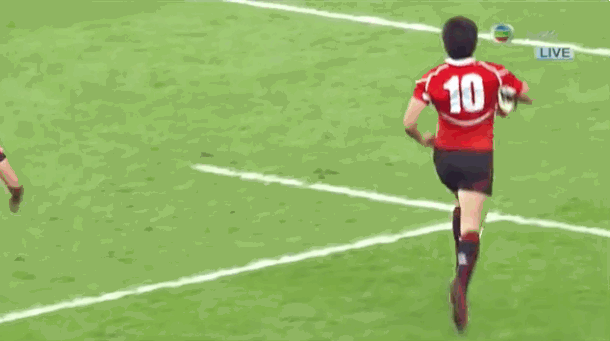
In many ways rugby is leading the way for sport technology. It has shown an open-
minded and considered approach to innovation. Each advance has been introduced with supporters, players, coaches, and referees in mind. It is important that they do not 'drop the ball' and keep innovating so that the viewing experience is improved into the future.
Jack O'Donoghue
References:
Comments