ZOOM-ing past Education Barriers
- odonogj2
- Jan 5, 2021
- 5 min read
Updated: Mar 20, 2021
Che Guevara’s legacy has grown and expanded since his death. The reach of the revered revolutionary goes around the globe. His image is iconic, his life an inspiration, and his ideas a catalyst for change. And because he symbolises so much for so many, it can be difficult to understand what he represented in himself.
In researching Che quotes for our twitter page, I began to notice how often he spoke about education, and how passionate he was about the subject. In particular he focused on how ignorance continued the cycle of capitalist exploitation, and thus how education was the primary assignment for any aspiring agitator.
Education is the most powerful weapon which you can use to change the world - Nelson Mandela
Education to Ernesto

Che had to be home-schooled due to his severe asthma, but luckily that did not obstruct his appetite for knowledge. He was passionate about philosophy, politics, and history, while also showing an interest in mathematics and engineering. He studied the poetry of the greats throughout his life: from John Keats to Gabriela Mistral. In fact, when he died he held a collection of great poems that he had copied by hand (Phillips, 2017). In his home, Che had access to over 3,000 books and he soon found great curiosity in the work of Karl Marx, Robert Frost, and Miguel Asturias. This developed into a passion for writing based the ideas of those writers as well as philosophers such as Nietzsche and Freud. Che then went on to study medicine in the University of Buenos Aires, and received his medical degree in 1953 (Harper, 1969) (Henry, 2003).
As much as Che was his own man, with his own mind, his early education and influences lay the foundations for his socialist spirit and revolutionary rage. His medical interest in leprosy led him to travel South America on motorcycle, and this experience helped him to understand the poverty and disease in his continent. His reading of Marx stirred pure contempt for capitalism. His education allowed him to see the exploitation that was taking place, while also empowering him to cause change.
The first duty of a revolutionary is to be educated - Che
Accessibility in Education
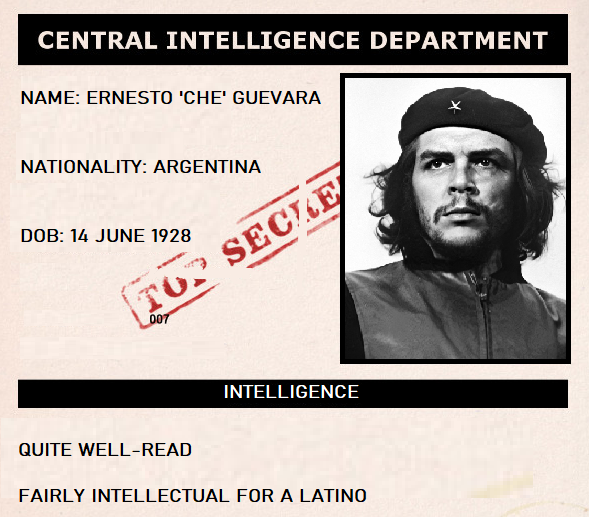
A CIA report from 1958 described Che Guevara as “fairly intellectual for a Latino.” At the time he was a graduated physician, who had studied the greats of Western and Latin poetry and prose, who had worked in the Mexico City General Hospital, and had strategized the overthrowing of the Cuban government. And yet, he was only considered to have been “quite well read” and “fairly intellectual.” Of course, that assessment is grounded in complete ignorance and racism, but it was true to say that the average person in South America was not being given the same educational opportunities as a person in the USA. Che sought to change that.
Therein lay a huge part of Che’s reasoning for fighting against imperialism. Che understood the importance of education (as he himself had been a benefactor of the privilege) and he wished to use it to fight for the education of others. A cycle of education would only lead to an improved society for all. On the morning of his death, Che spoke to the teacher of the local school in Bolivia where he was being held captive. He had explained to her that the reason for his fight against the oppressors, was to improve the condition of small schools like hers. That by battling against government officials driving fancy cars, he may be able to force change and facilitate the education of millions (Phillips, 2017).
The walls of the educational system must come down, education should not be a privilege - Che
Education Technology Today
For years, technology within the classroom has made learning more accessible for students with a variety of abilities. A range of technological tools have helped teachers to offer personalised and immersive education programmes to students. Nowadays a wave of education technology has encouraged virtual classrooms and wireless resources, making learning more accessible to people all over the globe, with different backgrounds (The Economist, 2018). Social Entrepreneurships like Camara, set up by Cormac Lynch, aim to use that technology to educate millions of children around the globe (Camara, 2021).
Personalised: Google Classroom is a learning management system that enables and encourages differentiated instruction teaching. It allows teachers to post resources that students can access at any time, thus learning at their own pace. Grammarly is an application used to help students that may struggle with dyslexia or other literacy issues. In universities such as Penn State, students with low-vision are using screen readers, refreshable braille displays, and tactile drawing boards to access course materials (Marr, 2020) (Baker, 2019).
Immersive: Applications like PowerPoint and or even video editors allow students to engage with and present information in an alternative way. Extended Reality (ER) is becoming more common, it encompasses virtual and augmented reality. ER Headsets can transport a history student to the Colosseum or can show an engineering student a life-size prototype. This practical technology allows students to visualise, comprehend, and learn by doing (Jobanputra, 2018) (Pando, 2017).
Global: Massive open online courses (MOOCs) are more prevalent than ever before, and offering new skills to over 11 million learners around the world. Recently with the COVID-19 Pandemic, we have seen movement away from the traditional classroom. Video conferencing technology from companies such as Zoom have allowed people to work and learn together, and the technology continues to improve with new features such as breakout-rooms allowing more engagement between students and their teachers (Pando, 2017) (Lynch, 2018).
Wireless: Some educational technology is redundant without access to high-speed internet. Kolibri is an open-source educational platform that provides offline access to educational resources for rural schools, refugee camps, orphanages, and other educational programmes. It works by allowing one user to download content online before sharing it to other users offline. Other applications such as Google Maps and Google Translate offer offline modes (Marchant, 2021) (Miller, 2020).

Che Guevara understood the power of education, and we can assume that he would have harnessed the power of technology to promote education. Some of the technologies mentioned above have helped to achieve Che's goals of providing education to all, regardless of background or ability. His legacy will live on in the Venezuelan 'Misión Che Guevara', a state-funded adult education programme introduced by Hugo Chávez. Were he still a leader today, we can only imagine the efforts Che would have made for his mission.
He who opens a school door, closes a prison - Victor Hugo
Sources
Guevara, C., 1995. The motorcycle diaries: a journey around South America. New York: Verso.
Guevara, E.C. and Guevara, E., 2003. Che Guevara Reader: Writings on politics and revolution. Ocean Press.
Durschmied, E., 2008. De Robespierre al Che Guevara. Ediciones Robinbook.
Kellner, D., 1989. Ernesto" Che" Guevara. Chelsea House.
Taibo, P.I., 1999. Guevara, also known as Che. Macmillan.
Abrams, D., 2010. Ernesto Che Guevara. Infobase Publishing.
Casey, M.J., 2012. Che's Afterlife: the legacy of an image. Vintage.
The Economist, 2018. In poor countries technology can make big improvements to education, [online] Available at: https://www.economist.com/international/2018/11/17/in-poor-countries-technology-can-make-big-improvements-to-education
Marr, B., 2020. The Top 5 Tech Trends That Will Disrupt Education In 2020, [online] Available at: https://www.forbes.com/sites/bernardmarr/2020/01/20/the-top-5-tech-trends-that-will-disrupt-education-in-2020the-edtech-innovations-everyone-should-watch/?sh=1b6e783f2c5b
Jobanputra, K., 2018. Top 6 Educational Technology Trends Right Now, [online] Available at: https://elearningindustry.com/educational-technology-trends-top-right-now
Marchant, N., 2021. 3 technologies that are making education more accessible, [online] Available at: https://www.weforum.org/agenda/2021/01/education-technology-accessibility-learning/
Pando, A., 2017. Ed Tech Makes Education More Accessible, [online] Available at: https://www.forbes.com/sites/forbestechcouncil/2017/12/01/ed-tech-makes-education-more-accessible/?sh=4a688db32a58
Baker, B., 2019. How Technology is Making Education More Accessible, [online] Available at: https://penntoday.upenn.edu/news/how-technology-making-education-more-accessible
Lynch, M., 2018. How EdTech Makes Learning More Accessible, [online] Available at: https://www.thetechedvocate.org/edtech-makes-learning-accessible/
Miller, J., 2020. 5 Ways to Make Technology Accessible for Students, [online] Available at: https://www.teachthought.com/technology/5-ways-make-technology-accessible-students/
Camara, 2021. Camara Education, [online] Available at: https://camaraireland.ie/
Harper, G., 1969. Ernesto (Che) Guevara - Physician, Revolutionary, [online] Available at: https://www.nejm.org/doi/full/10.1056/NEJM196912042812306
Henry, G., 2003. Che Guevara: A Revolutionary Doctor, [online] Available at: https://www.hcplive.com/view/3066
Phillips, K., 2017. ‘Do not shoot!’: The last moments of communist revolutionary Che Guevara, [online] Available at: https://www.washingtonpost.com/news/retropolis/wp/2017/10/09/do-not-shoot-the-last-moments-of-communist-revolutionary-che-guevara/


Comments