Internet of Guerrilla Warfare Things
- Patrick Byrne

- Dec 9, 2020
- 4 min read
Updated: Jan 25, 2021
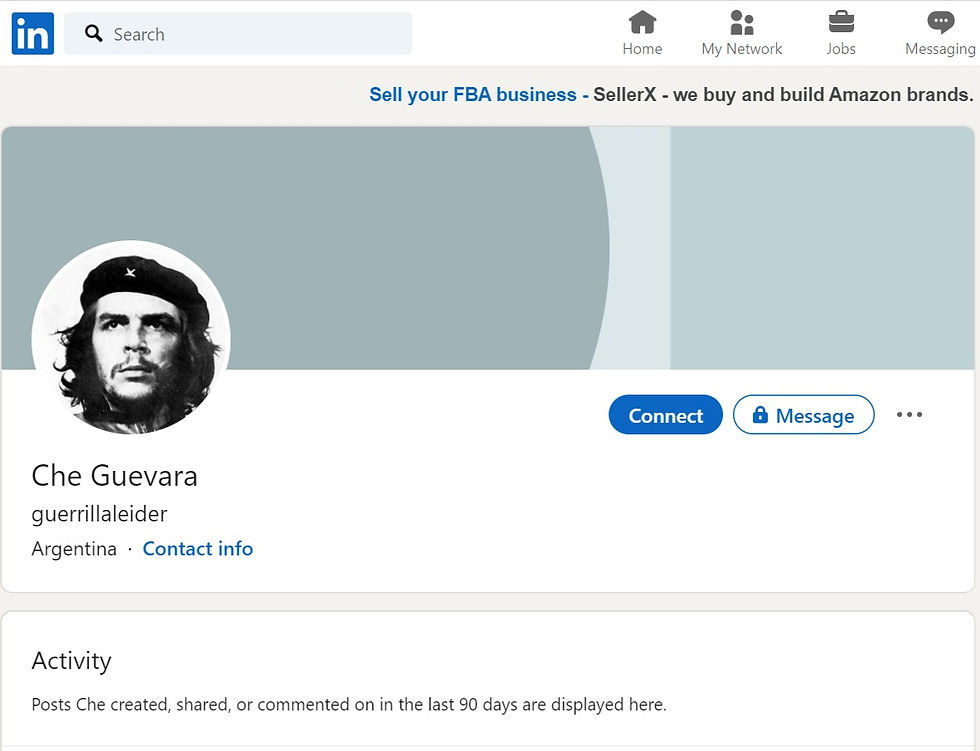
Che Guevara perfected the art of guerrilla warfare... or did he.
This article aims to explain what Guerrilla Warfare is, how Che Guevara leveraged it, and how the Internet of Things could have made it more effective.
Guerrilla Warfare
If you're like me, you've thought for however long you've been on this planet that Guerrilla fighters were named after the fierce unpredictable wild creatures, Gorillas, but like me, you would be wrong.
The word guerrilla is derived from the Spanish word Guerra which means 'small war.' Guerrilla warfare is seen as a brutal unconventional war style, but Guerrilla Warfare is as old as humankind. Tribal warfare is essentially guerrilla warfare. They had no command and control structure; they don't wear uniforms and don't engage in a toe to toe frontal battle that has characterised the western way of war for centuries. Tribes prefer to engage in ambush and surprise attacks, pillage, plunder and escape before the enemy warriors are alerted. Those are the characteristics of both ancient tribal warfare and of modern guerrilla warfare. In contrast, conventional war is a relatively new concept.
Guerrilla fighters are now referred to as irregular soldiers, usually fighting in small groups in the jungle, mountains, or countryside. Typically against an occupying or invading army in some resistance. Guerrilla war is structured around hit-and-run tactics. A mobile and strategic approach is the most critical factor when striking a larger army in this way.
In 1956 Che found himself in Mexico, where he met and joined a group of Cuban rebels lead by Fidel Castro. They invaded Cuban to fight against the dictator Batista. They fought this Guerrilla war for two years in eastern Cuba.
The guerrilla band's unconventional tactics can be narrowed down to the strict guerrilla doctrine of utilising advantageous terrain and the fundamental principle of not engaging in any battle, combat or skirmish unless it will be won. Guevara and Fidel's men would ambush and retreat, repeatedly without giving rest to the enemy.
The tactics of retreating and avoiding frontal engagements may appear cowardly. However, this is the general strategy of guerrilla warfare, which in its ultimate end is the same as any other war, to win.
This band of Cuban revolutionaries' most popular tactics would utilise is circling the enemy position from the compass's four points, north, south, east, and west. Positioning about five or six men at each point, maintaining enough distance to avoid being encircled themselves. The fight begins at one of the compass points, but as the enemy moves towards that position, those guerrillas would disengage, and the same process would start from another compass point. The enemy would again pursue the new direction of fire, and this band would again retreat. They would repeat these actions and, in turn, immobilise an enemy unit, forcing it to expend large quantities of ammunition and weakening their morale simultaneously without incurring great dangers to themselves. This tactic is extremely effective when executed correctly. The positioning of men is vital for this approach, and strong communication between each band is essential.
The Internet of Things
The Internet of Things is changing the world we live in. Sophisticated sensors and chips are embedded in the material things that surround us. Each transmitting valuable data. Data that lets us better understand how these things operate and work together.
The Internet of Things (IoT) describes this network of data emitting physical objects and how this data can be used to understand the systems around us better and solve real-world problems. These devices range from ordinary household objects to sophisticated industrial tools.
The process starts with the devices themselves which securely communicate with an IoT platform. This platform integrates the data from these devices and applies analytics to share the most valuable data to address industry-specific needs.
Over the past few years, IoT has become one of the most critical technologies of the 21st century. Now that we can connect everyday objects.
Using low-cost computing, the cloud and big data material things can collect and share information with minimal human intervention. In this hyperconnected world, digital systems can monitor, record, and adjust each interaction between these connected things. The digital world meets the physical world, and they cooperate.
Application of IoT
IoT's ability to provide sensor information and enable device-to-device communication is driving a diverse set of applications. The following are some of these applications and what they do.
IoT has made so many industries more efficient, effective, and productive. Sensors monitoring manufacturing machines allow them to be continuously analysed to ensure they are performing to their best ability. Products can also be monitored in real-time to address and identify quality defects.
Wearable technology can help monitor human health and environmental conditions. This technology enables a better understanding of the user's health and allows physicians to build up a more comprehensive understand of patients and monitor them remotely. Wearable technology also allows employers to track their employees' health and safety, which can be especially useful for workers employed in dangerous or hazardous conditions.
IoT is also improving the tracking of physical assets. Tracking products enables businesses to quickly determine asset location and ensure that high-value assets are protected from theft. Companies can use IoT fleet monitoring to direct trucks, in real-time, to improve efficiency.
IoT and Guerilla Warfare
Location tracking
By strategically placing sensors in the jungle where Guevara predicted the next battle, the guerrilla fighters could track the location and monitor movements to better understand and scrutinise their fighting technique. They could also be more away from their opponents' size and position and get the most comprehensive view of how to perfect this 4 compass approach.
Similarly, putting wearable technology on each of his soldiers would allow Guevara to monitor his own soldiers' position. Ensuring the structure of the attack is appropriate. The wearable technology would also transmit information of the soldiers' health, alerting him if anyone is hurt or tired and allowing Guevara to correct this in real-time but rescuing that soldier or distracting the enemy from another angle.
Sensors on their equipment can ensure ammunition is being used effectively and guns are working correctly, guerilla soldiers are usually not well funded so every piece of equipment must no be wasted. Therefor, a system for ensuring they are working as a well-oiled machine is vital.
References


Comments