Inside the Heart of the Heartless
- odonogj2
- Jan 27, 2021
- 8 min read
Updated: Mar 20, 2021
Ernesto Che Guevara was once asked, what is the most important quality for a revolutionary to possess? He answered, love.
A true revolutionary is guided by great feelings of love. Love of humanity, of justice, and truth - Che
Che was described as a “callous executioner” and a “man full of hatred.” Tales have been told of his mistreatment of both enemies and comrades, and many have theorised that his brutal methods simply reinforced militarism across Latin America. But Che was a human, who experienced and understood love. Publicly he conceptualised love for freedom and fairness, but privately he felt love in personal relationships.
Previous pieces have tried to magnify the man behind the myth and paint the person beyond the picture. Now, I want to highlight the heart inside the Che’s heartless exterior.
Are you Ready for Love?
An Irish proverb goes is folamh fuar é teach gan bean; meaning that a house without a woman is empty and cold. I like to think that this is less domestic-related, and more to do with how useless a man is without a woman. Having said that, another Irish proverb says there’s no torment like marriage, so maybe I shouldn’t follow their line of wisdom gung-ho.
I doubt that this seanfhocal was carried down to Che from his Irish ancestors, but it does seem that Che understood its message: man’s search for meaning lies in the love of a woman (or a man). The first step is to find that person (or in the case of Che, people).
Che Can't Help Falling in Love
Hilda Gadea Acosta was a Peruvian economist, author, and communist leader who entered Che’s life in Guatemala in 1953. They were kindred spirits, who bonded over their appetite to resist imperialism and shape Latin America around Marxist ideology. They introduced new philosophies and poets to each other, and Gadea initiated the relationship between Che and Fidel Castro. They were forced to flee to Mexico where they got married in 1955 and had one daughter, before Che departed for Cuba (Spalding, 2009) (Gadea, 2008).
Aleida March Torres was a Cuban revolutionary who met Che as a part of Castro’s resistance army in 1958. She recounted how Che was initially torn between being a leader in a disciplinary role and being an ordinary man with emotional needs. Ultimately they became close “within the maelstrom of war,” and March recalls how Che recited her a poem while preparing for battle, and how he first declared his love for her after the fight for Santa Clara. They married after in 1959, after Che’s divorce from Hilda, and they had 4 children together (March, 2012) (Haydock, 2017) (Shanks, 2002).
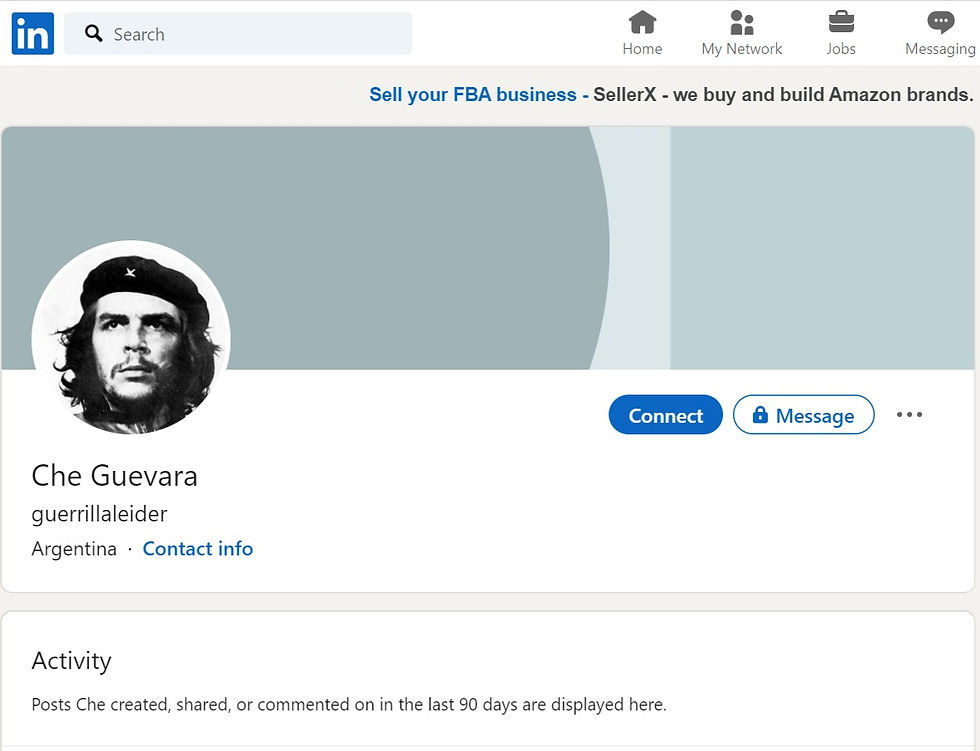
Che evidently made a connection with people that he had something in common with. In all fairness, it would be difficult to imagine him settling down with someone who didn’t share his fervent passion for revolution. Nowadays, the way we meet people has changed drastically. Dating apps and social media have broken down barriers. It begs the question (which has probably not been asked before) how would Che Guevara have fared on Tinder?
Finding in Love in the 21st Century
The landscape of relationships has changed forever with the introduction of online social media platforms and dating applications. In the 1960s, the vast majority of couples met through family and friends. Towards to the 1990s, more people began to meet in work or in bars. Nowadays, almost 40% of couples met online. Such a seismic shift is also noticeable with online matchmaking companies such as Tinder and Bumble being valued in the billions (Bucholz, 2020) (Shashkevich, 2019).
Why are these services so popular? According to Stanford sociologist, Michael Rosenfeld, people have always wanted to have a screening process in their search for romance. In the past, friends and family acted as this screen but now online dating apps have occupied the intermediary role. This is because online dating has been destigmatised and people are beginning to trust their algorithms. This is on top of the advantages of scale with online dating systems containing massive pools of information on potential suitors (Taylor, 2019) (Park, 2019) (Shashkevich, 2019).
So how do online dating apps work? Well, it’s difficult to know since these companies hold their intellectual property very close to their heart. What we do know is that they take your data. This includes personal information that you provide, but also data from connected social media accounts, data from in-app conversations, and analytics on website tracking. Using this data, matching algorithms attempt to shape your suggested matches. In fact, many of these dating apps compute a rating system for profiles based on your matching success. This helps with features such as ‘Most Compatible’ and ‘Top Profiles’ (MIT, 2017) (Fetters, 2018) (Heilweil, 2020).
And how might Che have fared? It’s hard to imagine Che giving personal data to a 3rd party app, especially one floating on the New York Stock Exchange. It’s also hard to picture him swiping right on profiles, or using cheesy-chat up lines to initiate conversation. However Rosenfeld’s studies indicate that online dating is a natural way of socialising, given the technological capabilities we have today. In the case of Che, he married 2 people with whom he shared intellectual and ideological common-ground. He met them through his fight against imperialism. So maybe dating apps would have opened him up to a new pool of romantic candidates; women who perhaps didn’t share his passion for protest. Having said that, we can only imagine that an algorithm would quickly pick up on Che’s interests, so his suggested profiles may have simply been filled with similar-thinkers.
Fight for this Love
Virginia C. Andrews wrote that love is the most dangerous experience for any human. She did not, however, attempt to overthrow capitalist regimes across 3 continents. So it is hard to say that her point is definitively correct.
What we do know is that while Che fought battles all over the globe, he also fought to keep the love alive in his relationships. In the immortal words of Cheryl: “anything that's worth having, is sure enough worth fighting for.”
Che's Fight to Keep the Love Alive
Unfortunately, things didn’t work out for the two like-minded Marxists; Che and Hilda Gadea. When Gadea came to Cuba, he announced to her that he had fallen in love with Aleida March (Spalding, 2009) (Gadea, 2008). They agreed on a divorce, but that did not stop Gadea from supporting his movement in Cuba for the rest of her days. Che’s marriage with March lasted until his passing, although he spent most of his time travelling the world and fighting revolutions (March, 2012) (Haydock, 2017) (Shanks, 2002).
Che was undoubtedly torn between the love in his personal relationships, and his love for changing the world. His time apart from Gadea in Cuba, had led him to pursue March. And then his marriage with March was consumed (and ultimately ended) with international escapades. If only he could have had the technology to instantaneously connect with them from across the globe. The concept of long-distance-relationships is both familiar and scary to this generation, but to Che, such an opportunity would’ve been a blessing.
I Just (Video) Called to Say I Love You
This era has been described as the Golden Age of Long-Distance Dating. Technology has broken down geographic barriers, and made Long Distance Relationships (LDRs if you want to impress some younger relatives) a real possibility. Although couples may be thousands of miles apart, they are always together through the internet, sending instantaneous love letters over land and sea.
Today, there is debate about whether the LDRs can improve communication and intimacy between a couple. Researchers from Cornell have even researched the impact on relationship communication. Having said that, it’s hard to imagine anyone choosing to be apart from the one they love. So for the piece, I think we just need to consider how technology would've helped Che to reduce the emotional distance of his global escapades (Herrera, 2018) (Shashkevich, 2019).
Instant Messaging: Studies in the 1990s described how mobile phones and the internet saw “the death of distance.” This proclamation may have been a tad premature, but as technology continues to develop, distance becomes less of an issue. Instant Messaging (IM) services first became available around the 1990s with AOL’s online community. WhatsApp now has over 2bn worldwide users, while Facebook Messenger has 1.3bn, and WeChat has 1bn. Such services would’ve allowed Che to message his wife even while he fought in the Congo. Some IM applications today even have encryption utilities which would have provided a layer of security to Che as he operated in covert missions (Tyson & Cooper, 2020) (Bucher, 2020) (Petronzio, 2012).
Video Chatting: While IM services are used for greetings, quick questions, and general asynchronous conversations, video chat allows for deeper conversations with focus and connection. Studies have shown that the primary reason for video conversations is to see the other person. Skype began offering their services in 2005 and many companies followed suit. The COVID-19 Pandemic has given necessity to a wave of innovations in the area, particularly with Zoom. This year, more than 60% of Americans regularly use these platforms for work or social reasons, and if Che were alive today he would undoubtedly do that too (Edwards, 2020) (IPSOS, 2020) (Neustaedtar & Greenberg, 2012).
Beyond Conversation: Communication over messaging services or video applications is not the only effect of technology on LDRs. Nowadays, one could feasibly track their significant other with Google Maps. A couple can watch a movie simultaneously with Netflix Party. Presents can be sent with next-day delivery from Amazon Prime. Couples can even be in the same (virtual) room with the use of Extended Reality. The possibilities continue to grow.
Once again, it is a little difficult to imagine the Che Guevara sending a gif over WhatsApp or fumbling over a mute button on Zoom. But after all, love can make anyone act a little crazy.
Sources
Guevara, C., 1995. The motorcycle diaries: a journey around South America. New York: Verso.
Guevara, E.C. and Guevara, E., 2003. Che Guevara Reader: Writings on politics and revolution. Ocean Press.
Durschmied, E., 2008. De Robespierre al Che Guevara. Ediciones Robinbook.
Kellner, D., 1989. Ernesto" Che" Guevara. Chelsea House.
Taibo, P.I., 1999. Guevara, also known as Che. Macmillan.
Abrams, D., 2010. Ernesto Che Guevara. Infobase Publishing.
Rosen, M., 2018. A look at the complex personal life of Che Guevara, [online] Available at: https://www.huckmag.com/art-and-culture/photography-2/a-look-at-the-complex-personal-life-of-che-guevara/
Shanks, D., 2002. Carrying on her father's fight for socialism, [online] Available at: https://www.irishtimes.com/news/carrying-on-her-father-s-fight-for-socialism-1.1054470
March, A., 2012. Married to Che, [online] Available at: https://www.smh.com.au/entertainment/books/married-to-che-20120428-1xri0.html
Haydock, S., 2017. Che Guevara's daughter remembers her father, [online] Available at: https://www.theguardian.com/world/2017/dec/08/che-guevara-daughter-normal-family-aleida-fidel-castro
Spalding, H., 2009. Hilda and Che, [online] Available at: https://nacla.org/news/%E2%80%98-great-feeling-love%E2%80%99-hilda-and-che
Gadea, H., 2008. My Life with Che, [online] Available at: https://www.kirkusreviews.com/book-reviews/hilda-gadea/my-life-with-che/
Bucholz, K., 2020. How Couples Met, [online] Available at: https://www.statista.com/chart/20822/way-of-meeting-partner-heterosexual-us-couples/
Heilweil, R., 2020. Tinder may not get you a date. It will get your data, [online] Available at:https://www.vox.com/recode/2020/2/14/21137096/how-tinder-matches-work-algorithm-grindr-bumble-hinge-algorithms
Park, W., 2019. How dating app algorithms predict romantic desire, [online] Available at: https://www.bbc.com/future/article/20191112-how-dating-app-algorithms-predict-romantic-desire
Shashkevich, A., 2019. Meeting online has become the most popular way U.S. couples connect, [online] Available at: https://news.stanford.edu/2019/08/21/online-dating-popular-way-u-s-couples-meet/
Taylor, C., 2019. Online dating isn't a game. It's literally changing humanity., [online] Available at: https://mashable.com/article/online-dating-change-world/?europe=true
MIT, 2017. First Evidence That Online Dating Is Changing the Nature of Society, [online] Available at: https://www.technologyreview.com/2017/10/10/148701/first-evidence-that-online-dating-is-changing-the-nature-of-society/
Fetters, A., 2018. The Five Years that Changed Dating, [online] Available at: https://www.theatlantic.com/family/archive/2018/12/tinder-changed-dating/578698/
Tyson, J., and Cooper, A., 2020. How Instant Messaging Works, [online] Available at: https://computer.howstuffworks.com/e-mail-messaging/instant-messaging.htm
Bucher, B., 2020. Global Usage of Messaging Apps, [online] Available at: https://www.messengerpeople.com/global-messenger-usage-statistics/
Petronzio, M., 2012. Instant Messaging History, [online] Available at: https://mashable.com/2012/10/25/instant-messaging-history/?europe=true
Edwards, B., 2020. History of Video Calls, [online] Available at: https://www.pcworld.idg.com.au/slideshow/350404/history-video-calls-from-fantasy-flops-facetime/
IPSOS, 2020. Coronavirus prompts increased use of video chat platforms for work, connection, [online] Available at:https://www.ipsos.com/en-us/news-polls/coronavirus-prompts-increased-use-of-video-chat
Neustaedter, C., and Greenberg, S., 2012. Intimacy in Long-Distance Relationships over Video Chat, [online] Available at: https://dl.acm.org/doi/pdf/10.1145/2207676.2207785
Herrera, P., 2018. The Use of Media Technologies in Long-Distance Relationships, [online] Available at: https://scholarworks.rit.edu/cgi/viewcontent.cgi?article=11084&context=theses#:~:text=The%20study%20also%20found%20that,in%20a%20long%2Ddistance%20relationship.&text=In%202007%2C%20Utz%20examined%20media,people%20to%20better%20express%20emotions.


Comments