Che and Cambridge Analytica
- rellisci

- Dec 17, 2020
- 4 min read
Updated: Mar 20, 2021
Cian Rellis - 17321736

As a doctor turned commander during Cuba’s left-wing revolution Che was courageous and brave leader. More importantly, Che was savvy. Upon arrival to Cuba Castro, Che, and the band of revolutionaries were immediately attacked by the Cuban military, leaving only a fraction of the group surviving the encounter. Che and this cohort of freedom fighters spent time regrouping in the Sierra Maestra mountains, receiving support from local guerilla networks. During this time The New York Times interviewed Castro, who was thought to have perished in their initial encounter with the Cuban military (Matthews, H., 1957). This piece propelled the disheveled revolutionaries to evolve into a piece of mythos in the world’s collective mind, they were larger than life itself. The media had created mythical characters out of these guerilla soldiers. From this moment, Che recognized the great power of the media and its importance in propelling systemic change in the world.
What Could Have Been
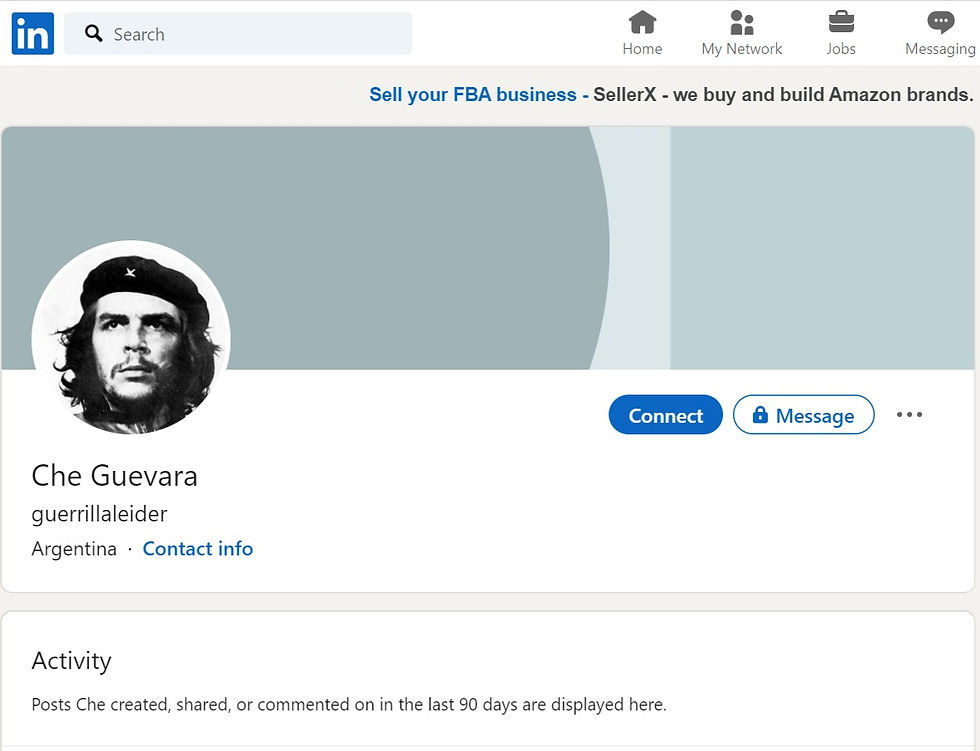
For the last few years of his life, Che dedicated himself to the cause of armed left-wing revolutions across South America and Africa. This eventually resulted in his death in Bolivia in 1967 ending his life and political journey in its tracks (Sinclair, Andrew Annandale., 2021). This was the end of Che Guevara, and as selfish as it is to impose our own stories and what if’s on a historical figure who has no input or experience into these topics, it is quite interesting to speculate and to ponder on such questions. How would Che have interacted with the media of today? How would he have responded to a modern society which is so centered around such media, social or otherwise? More importantly, as a leader, how would he have used this new form of media to his advantage.
If the man was alive today it would be easy to imagine him involved in election campaigns whether in Cuba or elsewhere. Che was very often in the limelight and was thrust into the public consciousness through repeated media appearance, appearing in magazines, radio broadcasts and even American television. In a post social media world, the battleground of public opinion is no longer contested through lengthy TV debates or radio broadcasts, rather it is won and lost over 280 characters, over videos and soundbites on social media and most importantly personalized advertising.
Big Data: A Big Win for Politicians?

It is now possible for political leaders to capture the expressions of their populace and effectively communicate with them the message which will have the most impact on each citizen individually. The victorious Obama presidential election campaigns of 2008 and 2012 were one of the first examples of the effective use of data analysis to refine their campaign messaging. By using feedback from voters coupled with descriptive data analysis the Obama campaign was able to fine tune what their message was, to whom they were targeting with the messaging and even where the most effective location was to deliver this messaging (Balz, D., 2013). A famous example of this was an Obama campaign concert with Bruce Springsteen and Jay Z, the location of this public address was changed to an area where the campaign was struggling in Ohio. Since 2012 this use of data has changed dramatically and in the 2016 US presidential campaign, several candidates employed the use of psychological profiling to effectively tailor their campaign messaging (Channel 4, 2016).
While I can make no assumptions over Guevara’s potential moral issues with such technologies, it is safe to say that to Che, the cause of socialist liberation was of upmost importance. It appears he would have done anything to ensure its realization and to fight back against imperialist aggression. For example: in an interview he claimed that had the Cubans been responsible for the nuclear missiles during the Cuban Missile Crisis that they would have fired them to retaliate against the threat of imperialist aggression from the United States (Anderson, J., 2012). Surely Che would recognize the power of these new medias and targeted marketing tools in swaying public opinion.

Cambridge Analytica was a British political consulting firm which focused on the use of big data to created targeted advertising campaigns designed to ‘change audience behaviour’. It’s services were successfully used by both Ted Cruz and Donald Trump during the 2016 American presidential election campaign. . The company used unauthorized, invasive techniques to gain access to an estimated 87 million Facebook profiles. Each invaded user profile’s likes, friend lists, political affiliation, religious views, personal details and even events the user had RSVPed to were scraped to create dataset of attributes about each user. Using this data, Cambridge Analytica created a psychometric model, a personality profile to sort every person into broader personality group which were then targeted with different political messaging to maximise the impact of the advertisement (Detrow, S., 2021). Cambridge Analytica used this data and Facebook’s targeted marketing tools to influence the behaviour of American voters. In the words of Christopher Wylie, a whistle-blower who previously worked for the company, they had created a ‘full-service propaganda machine’ (Osborne, H., 2018).

The world of Donald Trump becoming president of the United States and the world of Che Guevara earning a mythological status as a freedom fighter may seem worlds apart, both stories show the impact of media in influencing public opinion. While both incidents bookend a vast 60 years filled with many cultural changes, the continued use of media to influence public opinion illustrates that while technology may change over our lifetimes, the structures in our societies that have been used by leaders throughout history remain the same.
References
Anderson, J., 2012. Castro’s Defining Crisis. [online] The New Yorker. Available at: <https://www.newyorker.com/news/news-desk/castros-defining-crisis> [Accessed 5 January 2021].
Balz, D., 2013. How the Obama campaign won the race for voter data. [online] The Washington Post. Available at: <https://www.washingtonpost.com/politics/how-the-obama-campaign-won-the-race-for-voter-data/2013/07/28/ad32c7b4-ee4e-11e2-a1f9-ea873b7e0424_story.html> [Accessed 10 January 2021].
Channel 4, 2016. Cambridge Analytica: how big data shaped the US election. [online] Available at: <https://www.youtube.com/watch?v=CgYvf3Ckdso> [Accessed 05 January 2021].
Detrow, S., 2021. What Did Cambridge Analytica Do During The 2016 Election?. [online] Npr.org. Available at: <https://www.npr.org/2018/03/20/595338116/what-did-cambridge-analytica-do-during-the-2016-election> [Accessed 5 January 2021].
Matthews, H., 1957. Man in the News; Versatile Revolutionist; Ernesto Che Guevara (Published 1964). [online] Nytimes.com. Available at: <https://www.nytimes.com/1964/12/12/archives/man-in-the-news-versatile-revolutionist-ernesto-che-guevara.html> [Accessed 10 January 2021].
Osborne, H., 2018. What is Cambridge Analytica? The firm at the centre of Facebook’s data breach. [online] The Irish Times. Available at: <https://www.irishtimes.com/business/technology/what-is-cambridge-analytica-the-firm-at-the-centre-of-facebook-s-data-breach-1.3431749> [Accessed 5 January 2021].
TIME, 1960. CUBA: Castro's Brain. [online] Available at: <http://content.time.com/time/subscriber/article/0,33009,869742,00.html> [Accessed 1 March 2021].
Sinclair, Andrew Annandale., 2021. "Che Guevara". Encyclopedia Britannica, 5 Jan. 2021, https://www.britannica.com/biography/Che-Guevara. Accessed 12 March 2021.


Really enjoyable read! I wondered this myself.